
New Delhi | December 29, 2025
Sanjeev Sanyal, Member of the Economic Advisory Council to the Prime Minister, has sparked a nationwide debate by questioning the relevance of the UPSC examination and degree-centric education system in the age of Artificial Intelligence. Speaking at a public forum, Sanyal argued that India’s traditional approach to talent selection and assessment is increasingly misaligned with the demands of a rapidly evolving, technology-driven economy.
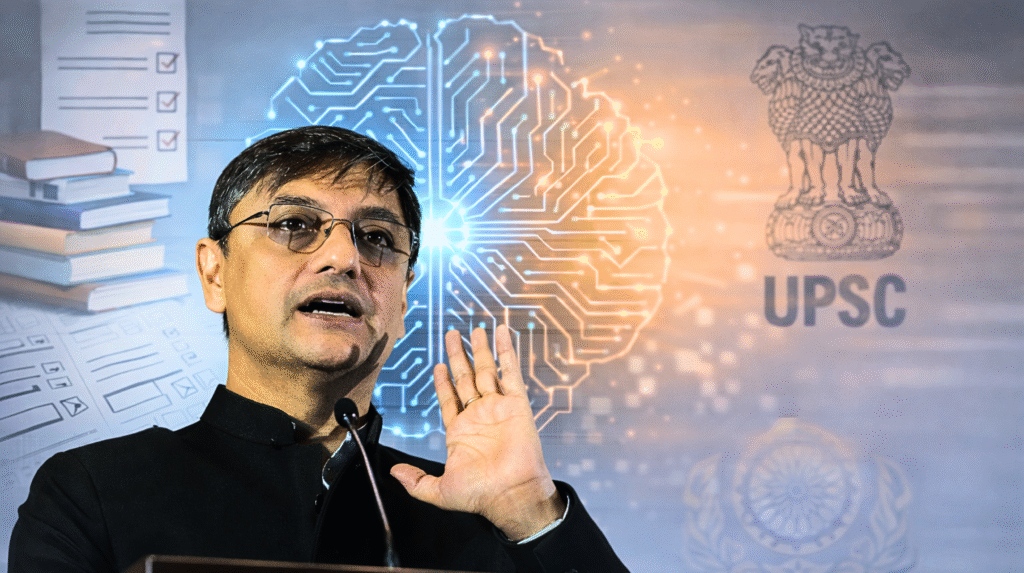
Sanyal pointed out that while the UPSC has historically played a crucial role in identifying administrative talent, its current format places disproportionate emphasis on rote learning, theoretical knowledge, and academic credentials rather than real-world problem-solving and adaptive skills. In an era dominated by AI, automation, and data-driven decision-making, he said such methods risk becoming outdated.
He further criticised India’s degree-based education culture, stating that formal qualifications often fail to reflect an individual’s actual capabilities. According to Sanyal, employers and policymakers should increasingly focus on skills, competencies, and demonstrated outcomes, rather than years spent preparing for examinations or accumulating certificates.
Highlighting global trends, Sanyal noted that many advanced economies are moving towards skill-based hiring, continuous learning models, and practical assessments, driven by AI tools capable of evaluating performance more accurately than traditional exams. He suggested that India must rethink how it identifies leaders, administrators, and professionals if it aims to remain competitive globally.
The remarks have triggered mixed reactions across academic, bureaucratic, and policy circles. While some experts welcomed the push for reform, others cautioned that institutions like UPSC ensure fairness, inclusivity, and meritocracy, especially for candidates from diverse socio-economic backgrounds.
Sanyal clarified that his comments were not aimed at dismantling institutions but at encouraging systemic reform to align governance and education with the realities of the AI era. The discussion has reignited conversations around education reform, civil services restructuring, and the future of public sector recruitment in India.
Disclaimer:
This article is based on publicly available statements, media reports, and official sources at the time of publication. The views expressed are those of the individuals quoted and do not necessarily reflect the views of this platform. Readers are advised to refer to official sources for complete and updated information. This content is intended for informational purposes only.